The Exit Is Through the Gift Shop: How Museum Retail Became the Headline Act
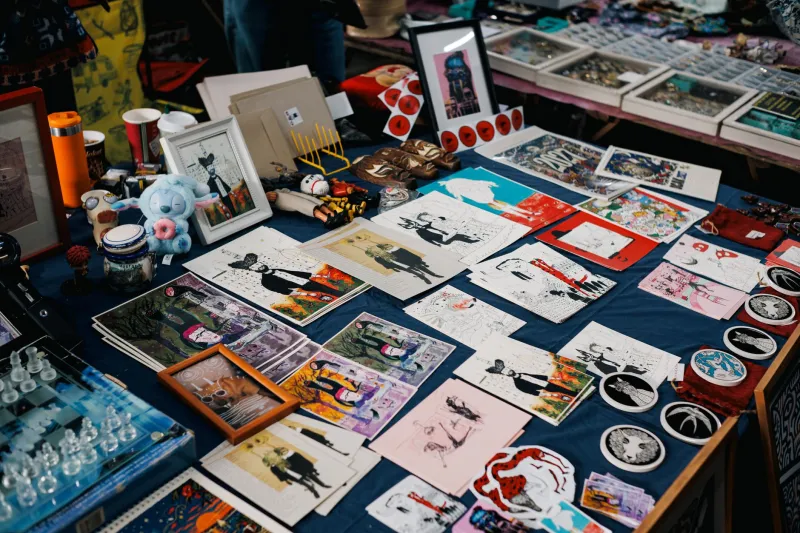
You can tell a lot about a museum by where the line forms. Twenty years ago it formed at the ticker counter. Now it forms at a folding table near the exit, where a limited run of 300 screen prints is going for $185 and the person at the front has been standing there since 9:40 a.m.
I watched this happen on a Saturday in October, in a city I won't name because the same scene was playing out in about nine others. The exhibition upstairs was good. The exhibition downstairs — and make no mistake, the shop is an exhibition now, lit and staged and sequenced like one — was better attended. People were photographing the tote bags. Actually photographing them. Held up against the wall, flash on.
The show arrives pre-packaged
Here's the thing nobody puts on the wall text: the merch is usually decided before the checklist is final. Loan agreements get negotiated, yes, but so do capsule collections, artist collaborations, exclusive print runs, and the licensing terms that let a museum slap an exhibition title on a candle. By the time the crates land, the retail plan has a launch calendar, a press strategy, and a target number.
That's not a scandal. Museums are expensive. The building has a roof, the roof has a problem, and the problem costs more than any endowment line item comfortably covers. Retail revenue is real revenue, and it has kept more than one curator's program alive through a lean fiscal year.
But there's a difference between a gift shop that funds the exhibition and an exhibition that functions as a content studio for the gift shop. We are drifting toward the second one, and we're drifting politely, so nobody has to say it out loud.
The clause in the contract
Ask a mid-career artist who has done a museum show recently about their agreement. Somewhere in it — sometimes in the loan paperwork, sometimes in a separate rider — is language about reproduction, derivative products, and collaboration. Increasingly it's a request, not a demand: would you design a small edition? Would you approve a colorway? Would you be open to a capsule?
The artist almost always says yes. Saying no reads as difficult, and difficult artists don't get the next room. What they get instead is a flat fee or a royalty percentage that, when you run the math against what a decent print run pulls in, tends to look like a rounding error.
So the work gets made twice: once for the wall, once for the shelf. And the shelf version has to be legible to a tired person holding a phone in one hand and a coat in the other. Which means it has to be simpler, flatter, more reproducible. Which means, slowly, the shelf version starts whispering to the wall version.
What the shop teaches the curator
The most underrated force in curatorial decision-making right now isn't a board member or a donor. It's a spreadsheet tab labeled something like retail potential.
I'm not suggesting anyone is censoring art to sell mugs. I am suggesting that when a programming committee weighs three possible exhibitions, the one with an obvious, photographable, high-conversion visual identity has a quiet advantage. A show about a movement with great posters beats a show about a movement with great ideas, because one of them produces a tote you can sell to someone who didn't buy a ticket.
The incentives compound. A blockbuster with strong merch raises the retail target. The raised target makes the next blockbuster's merch plan more aggressive. Three cycles later, the museum has a hit-driven calendar and a permanent collection that gets trotted out on the slow months. Nobody decided this. It just accumulated.
Who is actually paying for the art
Here's the part I keep circling back to. A $32 candle is, functionally, a donation with a scent. The person buying it is subsidizing the exhibition. That's a strange and kind of beautiful fact: the audience is underwriting the institution directly, one impulse purchase at a time.
But subsidy comes with expectations, and expectations come with taste. When retail becomes a meaningful share of earned revenue, the museum starts listening to the shopper in a way it never listened to the visitor. The shopper wants the thing they saw, in the color they saw it in, at a price that feels like a souvenir rather than a splurge. That's a narrow brief. Art is not usually narrow.
The uncomfortable bit
I don't want to end this by wagging a finger at museum shops, because I have bought the tote. I have bought two. One of them is genuinely good.
The question worth asking isn't whether museums should sell things. It's whether anyone inside the building has the standing to say this exhibition doesn't merchandise well and we should do it anyway. If that voice exists, and it's not the first thing cut in a budget cycle, the shop stays a shop. If it doesn't, the museum has quietly become a very well-curated retail environment with an art problem attached to the back of it.
Go see the show. Buy the print if you love it. Just notice, next time, which one the lighting was designed for.