Nobody Actually Lives Here: The Staged Homes Flooding Your Feed
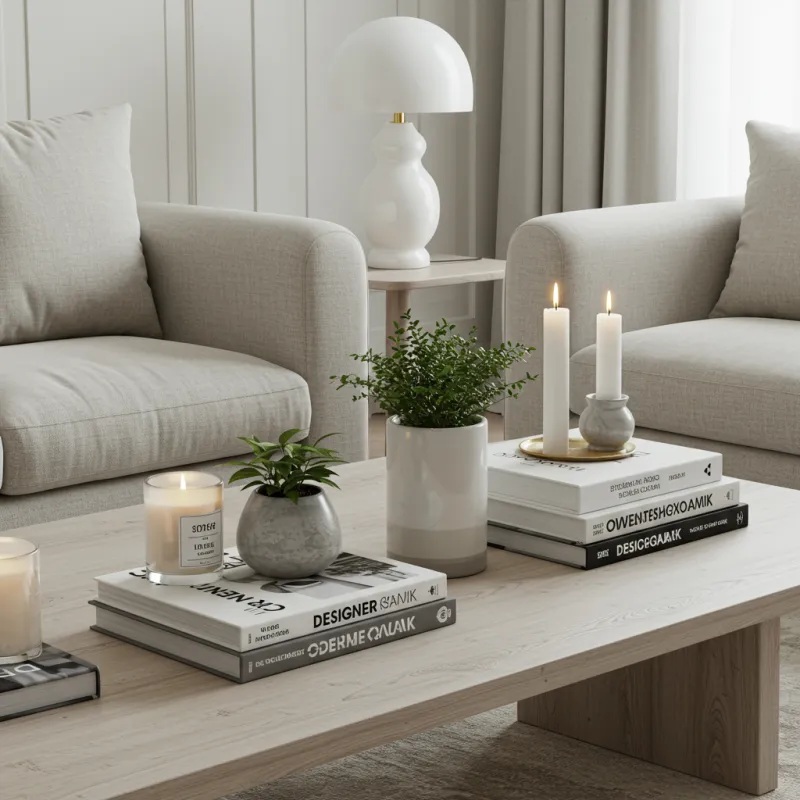
Photo: perfectly staged minimalist living room interior styled coffee table, via interiormock.ai
You know the room. Warm morning light raking across a linen sofa that has never been napped on. A single artfully bruised pear on a hand-thrown ceramic plate. One (1) dog-eared paperback, face down, as though the reader just stepped out to make pour-over coffee they will not drink.
It's the signature look of the internet's favorite genre: the fake lived-in home. And it might be the most successful stage set America has produced in decades.
Set Design With a Mortgage
The trick of these interiors is that they perform use without containing any. Everything signals a life — the rumpled throw, the half-open cabinet, the sneakers casually by the door — but nothing shows the residue of one. No scuffs, no mail pile, no evidence that humans shed hair and leave cups on surfaces.
It's theater in the most literal sense. A stage set is designed to be seen from one angle, under controlled lighting, for the duration of a performance. So is the aspirational Instagram home. The camera is the audience, and the photo is the entire show. Nobody has to eat breakfast there. Nobody has to live there. In many cases, nobody does.
Real estate flippers figured this out years ago: a staged home sells faster because buyers can't picture their own messy lives in it. The feed version of staging does the same thing to your taste.
When the Photo Is the Point
Here's the genuinely strange part: an increasing number of homes are being designed for the photograph, not for the occupants. Renovation choices get made based on how they read at 1080 pixels. Counters stay clear because clutter doesn't shoot well. Rooms get oriented toward the one wall with good light, like a face turned toward a window.
There's nothing new about aspirational decor — Americans have been buying magazines to feel bad about their drapes since the fifties. What's new is the feedback loop. The rooms that photograph well get shared, the shared rooms set the standard, and the standard migrates offline into actual renovation budgets. People are building real houses around imaginary lives.
The result is a visual language of authenticity that is more artificial than anything it replaced. The shabby chic farmhouse of the mid-2010s and the japandi calm of today both claim to reject polish. Both are executed with obsessive polish. Fraying linen, it turns out, is expensive.
The Taste Tax
What does this do to a person scrolling at midnight? It quietly recalibrates what a home is supposed to look like — and the benchmark is a room maintained by a stylist between shots.
The practical casualty is permission. Permission to have a plastic bin in view. A couch with an actual dent in it. A wall gallery that grew organically instead of being installed in one afternoon with a level and a caption about 'collected over time.'
Real homes are documents of use. They're scuffed at kid-height and dusty on top of the fridge. That's not a design failure; that's the entire point of shelter. The most interesting interiors — the ones in design history books — are almost always rooms that were actually occupied, hard, by actual people with actual clutter.
Photograph the Mess
None of this means you should renounce the pretty room. Beauty at home is a legitimate pleasure, and styling a shelf is a harmless joy.
But it's worth noticing when a room is performing occupation instead of containing it. Worth asking whether you're decorating a home or a backdrop. Worth, occasionally, posting the counter with the dishes on it.
The lie of the staged interior isn't that it's beautiful. It's that it pretends beauty and life are the same thing. They're not. One of them has a dent in the sofa.