Five Thousand Dollars or Five Bucks: The Vanishing Middle of the Art Market
There was a time — not a golden age, let's not romanticize it, but a real time — when a working person could buy original art without a financial advisor in the room. Five hundred bucks got you a painting from a gallery in Santa Fe or a co-op in Chicago. Five thousand got you something serious from an artist with a growing reputation. That price band was the art economy's middle class: the lifeblood that kept painters painting, printmakers printing, and galleries with actual art on the actual walls.
That middle is gone. And we should be honest about who killed it.
A Murder in Three Acts
Act one: the art fair-ification of everything. As fairs ballooned into luxury trade shows, galleries discovered that booth space in Miami or LA cost more than a year of rent. You can't survive that overhead on $800 sales. So galleries chased collectors, collectors chased blue chips, and the $500 painting quietly disappeared from the inventory — not because nobody wanted it, but because nobody could afford to sell it.
Act two: the NFT hangover. For about eighteen months, the digital art boom convinced an entire generation of artists that the middle market was obsolete — that the future was one collector paying 40 ETH, not forty collectors paying $200. When the crash came, it didn't just vaporize fortunes. It vaporized the habits of middle-market collecting: browsing, saving up, owning something physical from someone whose name you knew.
Act three: print-on-demand saturation. The internet flattened art pricing into a race to the bottom. When every image on Earth is available as a $30 poster, the psychological floor drops out. Buyers who might have stretched for an original now feel foolish doing so. Why own the painting when the print ships free?
The Black Market Nobody Calls a Black Market
Here's the hopeful part, and why I'll die on this hill: the middle market isn't dead. It went underground, and it's thriving — it just doesn't look like a gallery anymore.
Look at the artist-run subscription clubs, where collectors pay $25 or $50 a month and receive original works, zines, or editions in the mail. It's a record club for the visual set, and it does something galleries never managed: it creates recurring, predictable income for artists and ongoing relationships with collectors instead of one-time transactions.
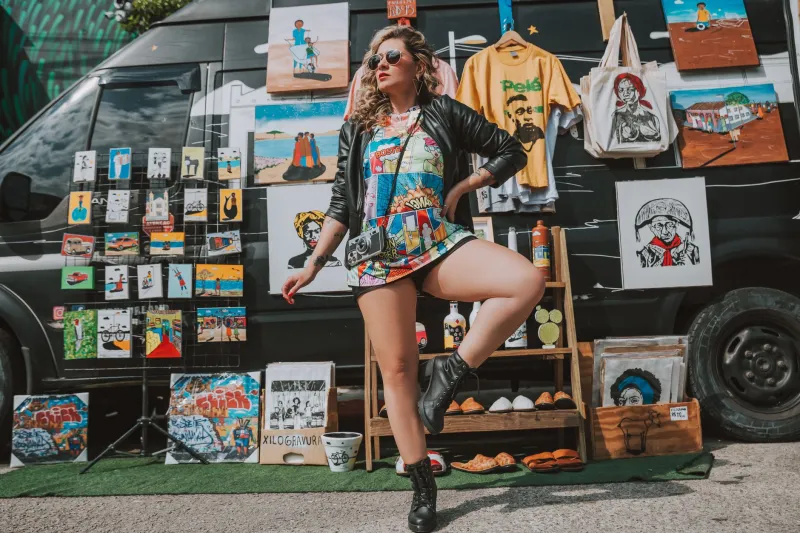
Look at the zine and print fairs — the small-press expos popping up in community centers, church basements, and actual parking lots from Portland to Philadelphia. Tables cost fifty bucks. Work costs five. And crucially, the money changes hands directly, artist to buyer, no 50% gallery split, no booth fee math.
Look at the pop-up economy: one-day shows in borrowed storefronts, trunk sales, open studios that function like farmers markets. Cash and Venmo. Art carried out under someone's arm.
Is this a "market" in the way Sotheby's understands markets? No. There's no appreciation curve, no provenance, no exit strategy. But that was always the con anyway — the idea that art is an asset class first and a human exchange second. The underground replacement runs on the original operating system: someone made something, someone else loves it, money moves.
Stop Waiting for the Gallery to Come Back
The mistake would be treating this underground economy as a consolation prize while we wait for the real market to recover. It's not coming back. The fair-industrial complex has no incentive to sell $800 paintings, and the platforms have no incentive to stop flooding feeds with posters.
So the move is to build the replacement on purpose. Buy from the table in the parking lot. Join the subscription. Pay the artist, not the intermediary. The middle-class art market won't be resurrected by institutions — it'll be rebuilt, transaction by transaction, by people who never needed permission to start.