Get Your Hands Dirty: Why Digital Creatives Can't Stop Touching Things
Let's start with a scene that's become surprisingly common.
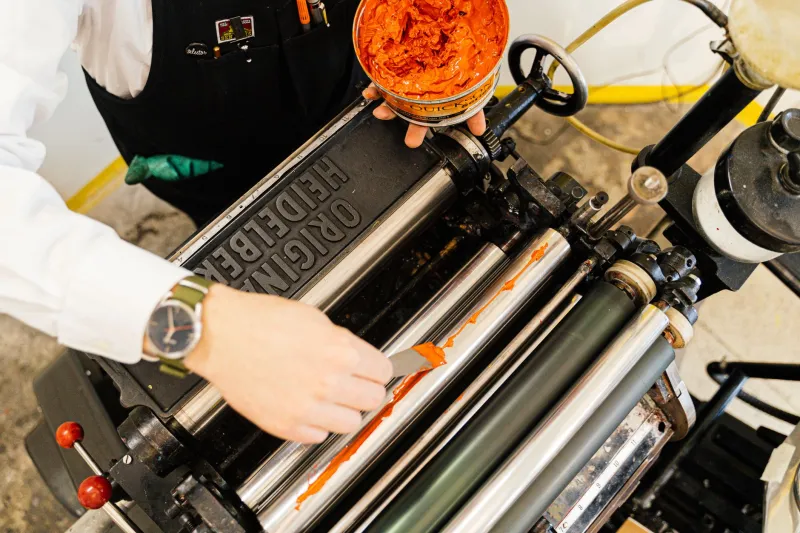
A designer — mid-thirties, fully capable of producing polished work entirely in Figma or Illustrator — is spending her Saturday morning rolling ink across a lino block she carved by hand. The print she's making won't be as precise as anything she could produce digitally in ten minutes. It'll have uneven ink coverage, slight registration issues, maybe a smudge or two. She knows this. She's doing it anyway, with visible enthusiasm, and the results — imperfect, textured, warm in a way her screen work rarely is — are ending up in her portfolio alongside the clean vector work.
This is not an isolated case. It's happening everywhere, and it's worth taking seriously rather than dismissing as nostalgia or aesthetic trend-chasing.
The Smoothness Problem
Digital tools got very, very good at eliminating friction. That was the whole point. Undo buttons, infinite layers, non-destructive editing, perfect gradients, crisp lines at any resolution — modern creative software is an almost miraculous friction-removal machine. And for a long time, that felt like pure progress.
But friction, it turns out, isn't just an obstacle. It's also information. When you're working with physical materials, resistance tells you something. The way ink spreads on different paper stocks. The way clay responds to pressure. The way a brush behaves when it's running dry. These resistances aren't bugs in the process — they're part of the conversation between the maker and the material, and that conversation produces outcomes that no amount of digital simulation has fully replicated.
Creators who've spent years working without that conversation are increasingly aware of its absence. Not in a sentimental way, necessarily. In a practical, almost physical way. The work feels like it's missing something, and the hands know it even when the brain is still making arguments for efficiency.
Texture as a Visual Language
Look at what's actually happening aesthetically and the physical turn makes a certain commercial sense too. Audiences have been marinating in hyper-polished digital visuals for so long that genuine texture — real grain, actual imperfection, the kind of mark that clearly came from a human hand rather than a rendering engine — reads as immediately distinctive.
This shows up in branding work, in editorial illustration, in motion graphics that deliberately introduce analog artifacts. Designers are scanning handmade paper. Illustrators are painting textures and photographing them to use as overlays. Type designers are creating fonts built from hand-lettered originals specifically to capture the subtle inconsistency of human mark-making.
There's something almost paradoxical about it: using digital tools to reproduce the evidence of analog process. But the paradox is less weird than it seems. What these creators are after isn't the inefficiency of analog work — it's the visual evidence of human presence, which digital perfection has trained us to read as cold or corporate by contrast.
Burnout Has a Texture Too
There's a less aesthetic and more psychological dimension to this that deserves honest attention.
Creative burnout in the digital era has a specific character. It's not the physical exhaustion of manual labor — it's the cognitive exhaustion of sustained screen work, the depletion that comes from spending eight hours a day in an environment that offers infinite possibility and zero tactile feedback. Everything is reversible, nothing has weight, and the work exists in a medium that doesn't push back.
A lot of creatives describe picking up physical materials less as a creative choice and more as a kind of decompression. The lino cutting, the collage work, the hand lettering — it forces a different quality of attention. You can't multitask while you're carving. You can't be half-present while you're mixing paint. The material demands that you actually be there, and that demand, paradoxically, feels like relief.
This is the part that separates genuine physical practice from aesthetic trend-chasing. If you're making handmade work because risograph prints are having a moment and you want the visual signifier, that's one thing. If you're doing it because your nervous system is asking for something that screens can't give you, that's something different — and probably more durable.
Is This Rebellion or Just Refreshment?
The skeptical read on all of this is that it's cyclical. Creatives periodically romanticize whatever tools they're not currently using. The digital artists of the nineties fetishized analog. The analog holdouts of the aughts eventually went digital. Now the pendulum swings back and everyone acts like they've discovered something.
There's truth to this. Not every designer buying a Risograph is making a principled statement about the soul of creative work. Some of them are just following a trend that photographs well for Instagram and distinguishes their portfolio from the sea of clean vector work.
But reducing the whole movement to trend-chasing misses something real. The conditions that are driving creatives back to physical materials — screen fatigue, the homogenizing pressure of digital tools, the specific kind of burnout that comes from working in frictionless environments — are not going away. If anything, they're intensifying as AI tools promise to remove even more of the labor from digital creative work.
When the software can generate a polished design in seconds, the handmade mark doesn't just become aesthetically distinctive. It becomes one of the few remaining signals that a human being was actually, genuinely, irreplaceably involved.
The Question Underneath the Question
Maybe what the physical materials revival is really about isn't tools at all. It's about what it feels like to make something.
There's a specific satisfaction in holding a physical thing you made with your hands — not a screenshot of it, not a JPEG, not a file that lives on a server somewhere, but an actual object with weight and surface and smell. That satisfaction doesn't make physical work superior to digital work. But it does address something that pure digital practice, for all its power and flexibility, consistently fails to provide.
The creatives getting their hands dirty aren't necessarily rejecting the screen. Most of them are going back to it on Monday. But they're learning something in the gap between the two modes — about their own process, about what makes work feel alive, about the difference between making something and producing something.
That's worth more than whatever aesthetic trend it gets wrapped in.